Shifting sunlight, bubbles, and silt constantly interfere with an autonomous underwater vehicle’s (AUVs) ability to find its way. GPS can’t help them, since water blocks its signals. Sound waves—the pings made famous by submarines—travel rapidly through water, yet they too have their limits, requiring a network of transponders that compromise an AUV’s autonomy.
To address these significant challenges, Mengxue Hou, assistant professor of electrical engineering at the University of Notre Dame, and her lab have developed an AI navigation system that enables an AUV to determine its coordinates using visual clues and evaluate the accuracy of those coordinates probabilistically.
Hou, together with first author and doctoral student Yu Zhou, published their results in OCEANS.
“We essentially built a system that allows an underwater robot to say, ‘I think I’m here, but I’m only 60% sure, so I should probably go back and double-check,’” said Hou. “This system provides a massive leap in confidence for navigating complex structures like piers and reefs.”

AI piloted underwater vehicles have a problem with overconfidence. The ocean is such a complex environment—fluctuating temperature, current, and visibility—that regardless of the number or sophistication of sensors added, an AUV can lose its bearings and veer off boldly in the wrong direction.
To correct for this, Hou’s team pairs a 3D scene rendering technique known as 3D Gaussian Splatting (3DGS) with a Bayesian framework, a mathematical approach that allows the system to quantify uncertainty.
Before launching the AUV on its mission, its “brain” is loaded with a 3DGS map with underwater shapes—the pillars of a pier, a coral reef, a rocky outcrop—represented as “fuzzy” ellipsoids (Gaussians). Since 3DGS renders objects as clouds of data, rather than as rigid, visual points, it more accurately reflects the inherent murkiness of underwater environments.
When the team tested its AUV in its simulator, HoloOcean, they demonstrated that in chaotic environments—full of view-obscuring piers and poles—or those which simply failed to provide sufficient data, the vehicle dialed back its confidence. Using a probabilistic Bayesian model, the vehicle recognized when it was appropriate to pause or revisit an area rather than make a navigation error.
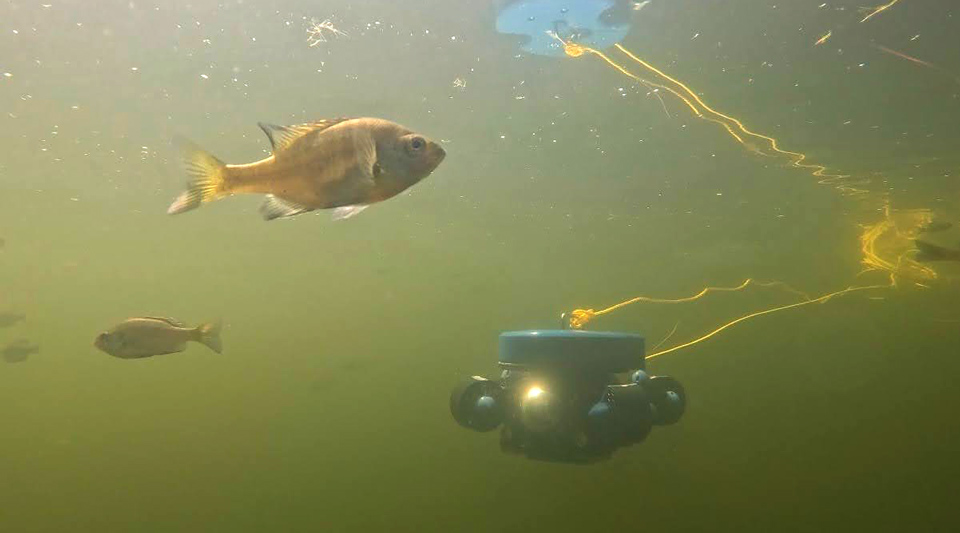
The team is now trying to take the technology out of the simulator and into the field. Hou’s lab deployed a miniature underwater vehicle, equipped with an onboard oxygen sensor, for field experiments at the University of Notre Dame Environmental Research Center (UNDERC) facility in Wisconsin to carry out an environmental monitoring mission.
“Our framework ensures a higher level of reliability for tasks like environmental monitoring or infrastructure inspection,” said Hou. “We’re moving beyond pre-programmed routes. By teaching robots to evaluate uncertainty in their knowledge of the surroundings, we are enabling active perception—where the vehicle realizes it lacks data and actively repositions itself to get a clearer picture of its surroundings.”
—Karla Cruise, Notre Dame Engineering