We assume that the blurring function is symmetrical, i.e., h(m,n)=h(-m,-n) and we use this fact develop a blind deconvolution/super resolution method based on magnitude retrieval from the phase of the image. When the blurring filter is symmetric with respect to origin, it does not change the phase of the original image. The restoration process becomes equivalent to the magnitude retrieval process. We also take advantage of the “plug and play” concept that uses deep neural network framework in an iterative method.
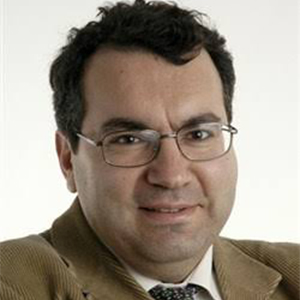
Ahmet Enis Cetin,
University of Pennsylvania
We describe a family of vector dot products that can be implemented using only sign calculations and addition/subtraction operations. The dot products are also energy-efficient because they do not perform energy consuming multiplication operations. Moreover, the vector products induce the ℓ1-norm. As a result, they are robust to outliers in data. We prove that some of the vector products satisfy Mercer’s condition and yield symmetric, positive semi-definite generalized covariance matrices, thus enabling Kernel Principal Component Analysis (KPCA) and related energy-efficient signal and image processing applications. We can also use the new vector products in “convolution”-like operations in deep neural networks.
In the second part of the talk, we will describe Haar Wavelet (or Hadamard transform) layers for neural networks to further reduce the energy consumption in edge applications. We will present practical Machine Learning applications. ML applications include (i) wildfire detection at the edge using cameras and (ii) sleep monitoring using infrared sensors.
Ahmet Enis Cetin received his B.Sc. from METU, Ankara, Turkey, and Ph.D. in 1987 from the University of Pennsylvania, USA. He was an Assistant Prof. at the University of Toronto between 1987-1989 in Canada. He was a faculty member at Bilkent University from 1987-2017. He is currently a professor in the Department of Electrical and Computer Engineering at the University of Illinois at Chicago (UIC). He also has held visiting professor positions at Bellcore (1988), University of Minnesota (1996-1997), and UC San Diego (2016-2017).
He has been carrying out research in the areas of theoretical and applied machine learning, signal, image, and video processing, biomedical signal processing, infrared and chemical sensor signal processing in Cyber-Physical Systems (CPS). His group introduced the concept of adaptive prediction and split vector quantization for Line Spectral Frequency representation. This concept was used in ITU speech coding standards including G.729, G.723.1 and GSM EFR. He became Fellow of IEEE for his contributions to signal and image recovery.
He is the Editor-in-Chief of Signal, Image and Video Processing, Springer-Nature. He received a best paper award for his camera-based wildfire detection work in a conference organized by UNESCO and Cyprus Presidency of the European Union. He is one of the co-founders of the multinational smart wide angle OEM camera company Oncam-Grandeye, UK. He served as the CEO/CTO of Grandeye, Turkey between 2003-2013. Oncam-Grandeye cameras won design and innovation awards in IFSEC, UK, and ISC WEST, Las Vegas, trade fairs.