What if a material’s very nature predisposed it to generating powerful terahertz radiation (THz)—a form of invisible light being explored for applications ranging from ultrafast communications and imaging to quantum technologies?
Most conventional terahertz sources generate these waves through fleeting electrical currents or rapidly moving charges. Researchers have now demonstrated a fundamentally different approach: setting a material’s own built-in electrical polarization into collective motion.
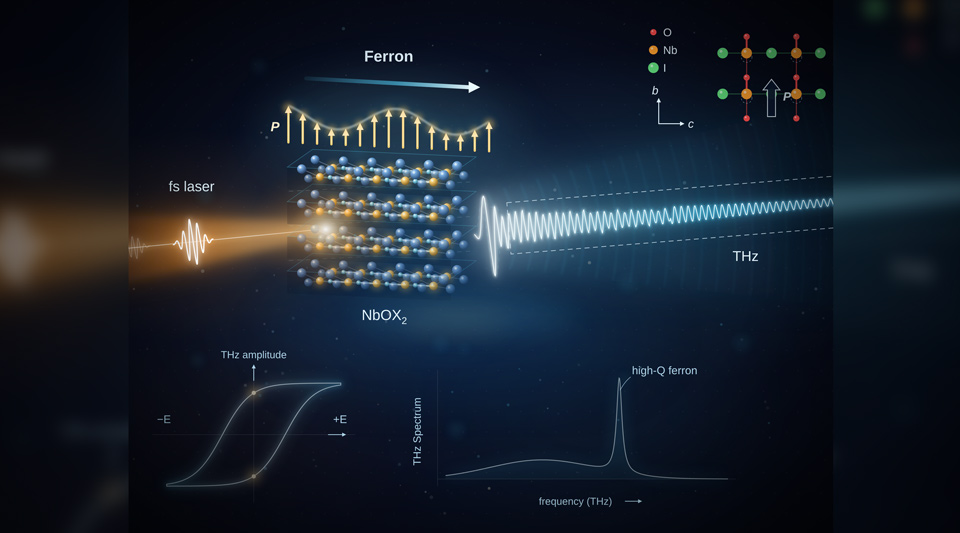
The researchers demonstrated this capability in thin, layered ferroelectric NbOX2 crystals made from niobium, oxygen and either iodine, bromine or chlorine. The resulting collective oscillations—known as ferrons—generate intense terahertz radiation that can be directly observed and electrically controlled. The results were published in Nature Physics.

“We normally think of ferroelectric polarization as a static electrical property of a material,” said Ranjan Singh, professor of electrical engineering at the University of Notre Dame, co-corresponding author of the paper and leader of the project. “What we show is that this ordered polarization can be set into coherent motion. These collective oscillations, called ferrons, behave almost like microscopic electrical tuning forks: they can radiate coherent terahertz waves, and remarkably, we can switch the phase of that radiation electrically.”
Ferrons are the electrical counterparts of magnons, collective excitations of magnetic order in matter. Previous research had provided evidence of ferrons, but their coherent dynamics, radiation and direct electrical control remained largely unexplored.
In ferroelectric materials, the arrangement of atoms creates billions of tiny electric dipoles, each with a positive and negative end. When these align, they give the material a built-in electrical polarization—picture billions of tiny electrical arrows pointing collectively in the same direction.
In collaboration with materials scientist Zheng Liu and team at NTU Singapore, Singh and his team found that exciting the NbOX2 material with an ultrafast laser pulse sets its polarization into coherent collective motion, oscillating trillions of times per second. As the electric polarization oscillates, it emits electromagnetic waves—in this case, terahertz radiation.
“We were shocked that such a thin material could generate such a strong terahertz signal,” Singh said. “It’s only about eight microns thick, yet its terahertz energy-conversion efficiency per unit thickness is about 100,000 times greater than that of zinc telluride, the reference material we used for comparison.”
The oscillations were remarkable not only for the strength of the radiation they produced but also for how long they persisted. Like a tuning fork continuing to ring after it has been struck, the ferrons produced unusually long-lived, sharply defined oscillations, even at room temperature.
The researchers also found that terahertz radiation generated by one film could set ferrons oscillating in another—much as one tuning fork can cause another tuned to the same frequency to vibrate. Even a relatively weak terahertz signal produced a strong response when precisely matched to the ferron’s natural frequency.
The frequency at which the ferrons “ring” can also be tuned by changing the material’s composition.
“We keep the niobium and oxygen the same but change the third element—using either iodine, bromine or chlorine,” Singh said. “That allows us to control how fast the polarization oscillates and, therefore, the frequency of the terahertz radiation it produces.”
Finally, the researchers demonstrated electrical control. Reversing the material’s polarization with an electric field reversed the phase, or polarity, of the emitted terahertz oscillation. Even after the electric field was removed, the material retained its switched polarization, effectively “remembering” its electrical state without requiring continuous voltage.
Together, the findings suggest a new approach to terahertz technology in which the ordered electrical state of a material itself becomes an active, coherent radiation source rather than relying primarily on transient electronic currents.
—Karla Cruise, Notre Dame Engineering
Hero image caption: Ultrafast laser excitation drives coherent ferron oscillations in ferroelectric NbOX2, generating intense narrowband terahertz radiation.